back-to-top
x
close

Editor’s note: This story was aggregated from an article by Montclair Local. Click here to read the entire article.

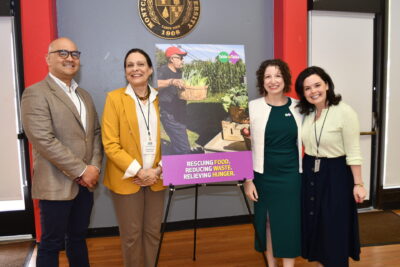
Nonprofit leaders, government officials, and community agencies gathered last week for the third annual Partners for Good Conference hosted by Table to Table, a food rescue organization serving North Jersey.

Related: How New Jersey Built the Country’s Most Ambitious Food Security Measurement Model

The daylong event, co-sponsored by Montclair State University’s Social Work and Child Advocacy Department, brought together food pantries, shelters, and service providers that distribute surplus food to residents across Bergen, Essex, Passaic, Hudson, and Morris counties.

Related: New Jersey Publishes 3-Year Food Security Strategic Plan

The conference featured panel discussions, breakout sessions, and presentations focused on challenges facing food assistance providers, including rising demand and limited resources. Officials from the New Jersey Office of the Food Security Advocate also presented the state’s new Food Security Strategic Plan and answered questions from attendees.


Table to Table is New Jersey’s first and largest food rescue nonprofit, bridging the gap between food being wasted and people facing food insecurity. We bring rescued fresh, nutritious food to 276 community partners, including social service organizations, pantries, shelters, fresh produce markets and centralized distribution hubs. Food is provided free of charge. Through this, Table to Table touches a diversity of those in need, including families, children, veterans, and older adults, making good nutrition accessible while serving as a stimulus for other longer-term benefits. Since 1999 we have rescued more than 133,271 tons of nutritious food — enough for 266,542,863 meals — and delivered it to our neighbors in need, saving over 612 metric tons of methane.

Related:

Montclair State University’s Social Work and Child Advocacy Department Co-Sponsors Event 

April 30, 2025 – Saddle Brook, NJ – Table to Table, New Jersey’s first and largest food rescue organization, successfully concluded its third annual Partners for Good Conference co-sponsored by Montclair State University’s Social Work and Child Advocacy Department. The Partners for Good Conference is designed to connect, inform and empower the nonprofit’s partner pantries, social service agencies, shelters, and other community partners, who distribute the surplus food delivered by Table to Table to communities in need throughout Bergen, Essex, Passaic, Hudson, and Morris counties.  

“This year’s Partners for Good Conference provided our community partners with an interactive venue to network, learn, and share resources to support their vital work in our communities,” said Heather Thompson, Executive Director, Table to Table. “Many of our partners are navigating extraordinary challenges – increasing need among our neighbors, limited staffs and budgets, and a multitude of unpredictable circumstances. This annual gathering is an opportunity to not only share critical information and build connections among our partners; it also welcomes State and County leaders to listen and engage in our collective efforts to reduce food insecurity,” Thompson concluded.

The day-long Conference featured partner panels, breakout discussions, and presentations addressing critical and timely topics that were informed by Table to Table’s Community Advisory Board. The afternoon capped off with a discussion about New Jersey’s newly launched Food Security Strategic Plan led by Mark Dinglasan and Dr. Jenny Schrum from the New Jersey Office of the Food Security Advocate (OFSA). 

“OFSA applauds Table to Table for another successful Annual Partners for Good Conference. It was a pleasure for Dr. Jenny and me to present the statewide food security strategic plan and implementation tool kit to the attendees and to answer questions,” said Mark Dinglasan, Executive Director, NJ Office of the Food Security Advocate. “New Jersey’s food security efforts, including the strategic plan, are rooted in the belief that true food security can only be achieved through multisector partnerships that have consensus and collaboration among interconnected partners. Hunger, poverty, and food insecurity are insidious foes that are highly complex and interconnected. Our efforts to combat them must be just as interconnected, and it is through events like the annual Partners for Good Conference that we are able to build these rich connections,” Dinglasan concluded. 

“We were pleased to partner with Table to Table for the second year in a row to support these important efforts and realize Montclair State University’s mission to serve our state’s dynamic, varied communities,” said Milton A. Fuentes, Psy.D. Interim Chair, Social Work and Child Advocacy Special Advisor to the Provost/Professor, Psychology Department, Montclair State University.  

Table to Table’s Partners for Good Conference was made possible through the generosity of our sponsors: Montclair State University’s Social Work and Child Advocacy, College of Humanities and Social Sciences; ShopRite Inserra Supermarkets Inc.Horizon; Something to Talk About Marketing; Dorfman Abrams Music Accountants & Advisors; Bergen County Camera; and Premium Digital Office Solutions. 

About Table to Table 

Table to Table (http://www.tabletotable.org) is New Jersey’s first and largest food rescue nonprofit, bridging the gap between food being wasted and people facing food insecurity.We bring rescued fresh, nutritious food to 276 community partners, including social service organizations, pantries, shelters, fresh produce markets and centralized distribution hubs. Food is provided free of charge. Through this, Table to Table touches a diversity of those in need, including families, children, veterans, and older adults, making good nutrition accessible while serving as a stimulus for other longer-term benefits. Since 1999 we have rescued more than 133,271 tons of nutritious food — enough for 266,542,863 meals — and delivered it to our neighbors in need, saving over 612 metric tons of methane. 

###

Editor’s note: This blog post was aggregated from an article by the New York City Food Policy Center at Hunter College. Click here to read the entire article.

Government has always tracked food security through the lens of affordability through the U.S. Census Bureau’s Current Population Survey, which is distributed annually to about 40,000 households.

The definition of food security as adopted by the United Nations’ Committee on World Food Security, is a condition where all people, at all times, have physical, social, and economic access to sufficient, safe, and nutritious food that meets their dietary needs and food preferences for an active, healthy lifestyle.

Related: 1 In 10 NJ Households Experienced Food Insecurity, New Report Shows

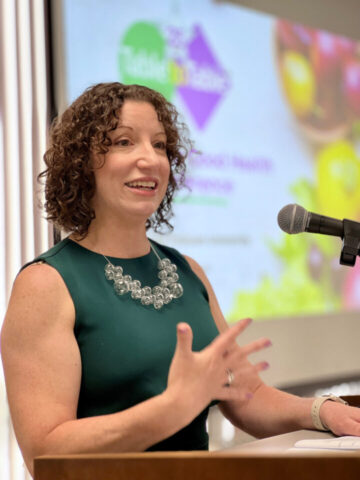
Dr. Jenny Schrum, the director of research and evaluation strategy at the New Jersey Office of the Food Security Advocate (OFSA), sought to go deeper with a new food security measurement model. The OFSA, headed by Executive Director Mark Dinglasan, is the first and only state-level food security agency in the country.

“We always associate food security with money, which is incredibly salient, but not the whole story,” Schrum told the New York City Food Policy Center. “If people have enough money, if may give you access. But there are many reasons people are food insecurity.”

As an outgrowth of the research, OFSA created the New Jersey Food Security Strategic Plan, a three-year initiative to guide and coordinate actions in addressing food insecurity statewide. A recent report by the U.S. Department of Agriculture released shows that one in 10 New Jersey households were food insecure between 2022 and 2024.

Related: New Jersey Publishes 3-Year Food Security Strategic Plan

Schrum’s research also led the OFSA to survey more than 2,000 New Jersey residents from communities with high rates of food insecurity. Those findings were documented in the OFSA’s Exploring the Six Dimensions of Food Security in New Jersey. The report has an interactive dashboard that lets readers explore results from the survey.

“With inflation, a changing economy, and climate change reshaping what we can grow and where, food insecurity is going to affect far more people than it does today,” Schrum told the New York City Food Policy Center. “If we only ever respond to the emergency, we never address what’s causing it. Better definitions, better data, better program data, that’s how we start to get ahead of it.”


Table to Table is New Jersey’s first and largest food rescue nonprofit, bridging the gap between food being wasted and people facing food insecurity. We bring rescued fresh, nutritious food to 276 community partners, including social service organizations, pantries, shelters, fresh produce markets and centralized distribution hubs. Food is provided free of charge. Through this, Table to Table touches a diversity of those in need, including families, children, veterans, and older adults, making good nutrition accessible while serving as a stimulus for other longer-term benefits. Since 1999 we have rescued more than 133,271 tons of nutritious food — enough for 266,542,863 meals — and delivered it to our neighbors in need, saving over 612 metric tons of methane.

Related:

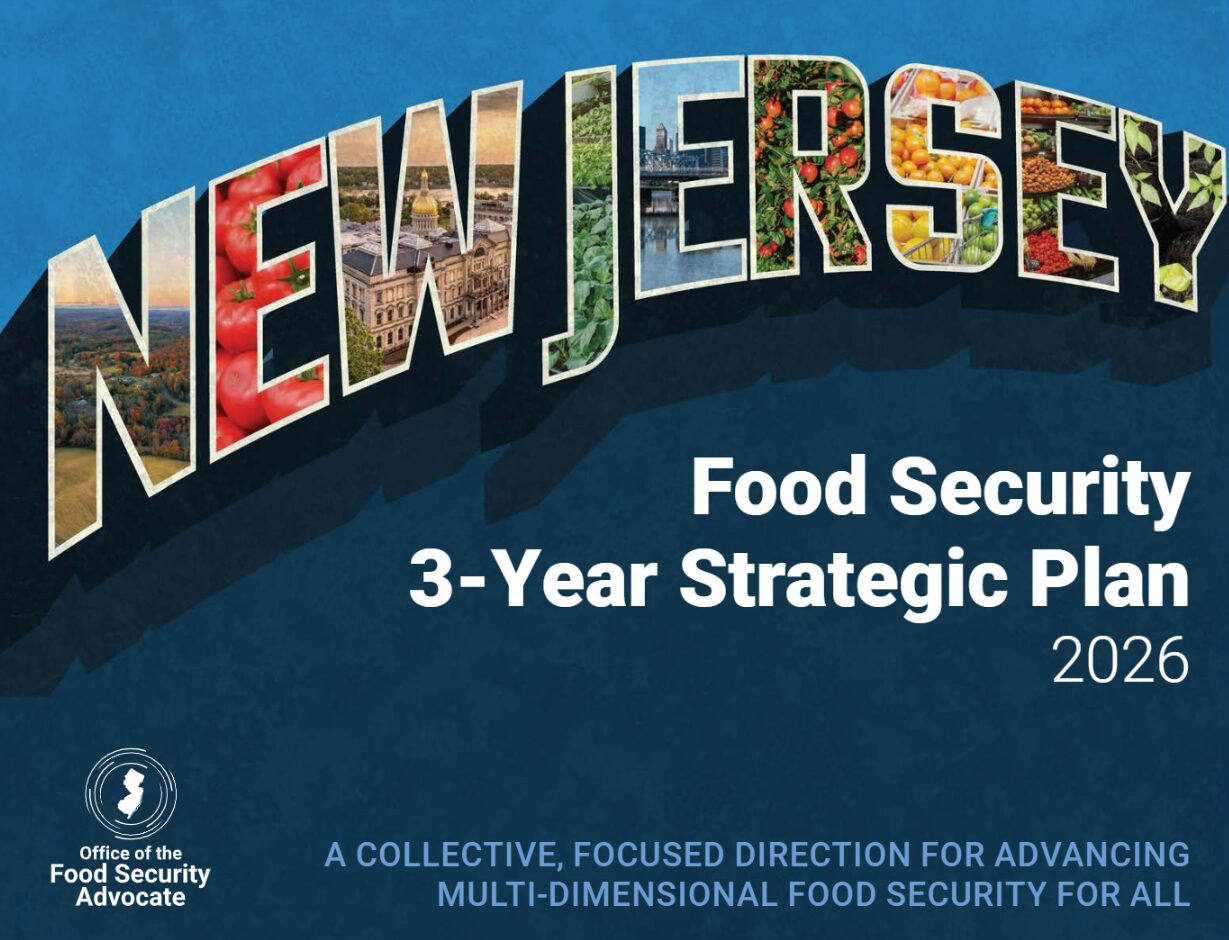
The New Jersey Office of the Food Security Advocate (OFSA) has published the New Jersey Food Security Strategic Plan.

The three-year plan outlines how the OFSA plans to coordinate statewide efforts to address the growing problem of food insecurity in New Jersey through a coordinated, cross-sector approach.

NJ_FoodSecurity_3Yr_StrategicPlan_010726_FINAL

“This is not a plan that tells New Jersey what to do. Rather, this is a plan that invites all New Jerseyans to see their food security work and everyday connection to the food system through a more holistic lens that acknowledges food insecurity as a highly complex, socio-economic issue,” said Mark Dinglasan, Executive Director of the OFSA. “This is the beginning of a journey to build a better tomorrow for New Jersey families.”

The plan has several focus areas:

Focus Areas
  • The Context of Food Security in New Jersey: This focus enhances and improves the exchange of information and access to improve the public’s awareness of food insecurity, optimize relief programs, and support data-driven decision-making.
  • Planning and Evidence: This describes the guiding principles, data, and evidence that informed the plan and explores the Six Dimensions of Food Security in New Jersey.
  • Strategic Direction: Outlines the plans focus areas and strategies, which help form a roadmap for advancing food security throughout New Jersey.
  • Accountability and Action: Defines what success looks like for the strategic plan and invites partners to use the plan as a call to action to help coordinate efforts statewide.
  • Strengthening Food Systems to Enhance Long-Term Stability: Includes improving the food supply chain to reduce food waste and enhance food security stability and sustainability, including sustainable farming practices and positioning food security efforts in climate action work.

The OFSA will be releasing a Implementation Tactics and Action Planning Toolkit in early 2026. This will provide guidance and practical tools for organizations to implement relevant strategies in their communities.


As New Jersey’s first and largest food rescue, our mission is to reduce food waste and provide nourishment to our food-insecure neighbors throughout North Jersey. We rescue millions of pounds of fresh, surplus food annually that would otherwise be wasted and end up in landfills. This rotting food emits methane gas, which contributes to climate change. We deliver this food to partner organizations who support the nearly 1.1 million people struggling with food insecurity in New Jersey.

Together, we can reduce food waste in our home and make a positive impact on the planet. Every little bit of effort — no matter how small — leads to change.

Related:

New Jersey awarded $1.2 million in grants to 36 institutions of higher education to combat food insecurity on their campuses. The grants will support campus-based resources, including food pantries and outreach connecting students with the Supplemental Nutrition Assistance Program (SNAP).

The grants were awarded through the Hunger-Free Campus Act. Through the program, institutions achieve a Hunger-Free designation and work to address student hunger through a Campus Hunger Task Force, a physical campus food pantry, and awareness raising initiatives, the New Jersey Office of the Secretary of Higher Education said in a press release.

This round of awardees reflects the grant’s widest reach since being created in 2019, with 90% of all public colleges and universities and 57% of eligible independent public-mission institutions receiving funding. In total, the state has invested $6.4 million over the last six years to address food insecurity among college students under the Act.

“These awards are the latest example of New Jersey’s investment in making food security a reality for everyone, everywhere. For college students to get help completing school meal applications for their children or applying for SNAP, being welcomed to use donated meal credits or shop for their households, means alleviating the stress that can derail their studies,” said Mark Dinglasan, executive director of the New Jersey Office of the Food Security Advocate.

Grant awards for fiscal year 2026 are:

Atlantic Cape Community College$52,500
Bergen Community College$27,500
Brookdale Community College$17,500
Camden County College$27,500
Centenary University$27,500
County College of Morris$17,500
Drew University$17,500
Essex County College$52,500
Fairleigh Dickinson University$17,500
Felician University$52,500
Georgian Court University$27,500
Hudson County Community College$52,500
Kean University$52,500
Mercer County Community College$27,500
Middlesex College$27,500
Monmouth University$27,500
Montclair State University$52,500
New Jersey City University$52,500
New Jersey Institute of Technology$52,500
Ocean County College$17,500
Ramapo College$17,500
Raritan Valley Community College$27,500
Rowan College at Burlington County$27,500
Rowan College of South Jersey$27,500
Rowan University$27,500
Rutgers University, Camden$52,500
Rutgers University, New Brunswick$17,496
Rutgers University, Newark$52,500
Saint Peters University$52,500
Salem Community College$27,500
Stevens Institute of Technology$17,500
Stockton University$27,500
Sussex County Community College$27,500
The College of New Jersey$17,500
Union College of Union County, New Jersey$27,500
William Paterson University$52,504

OSHE applied a new equity-focused distribution model that considered each institution’s percentage of eligible students to reach those experiencing the greatest need and to respond following disruptions to those students receiving SNAP benefits. Findings from OSHE’s Spring 2025 Student Food Security Survey of 11,877 students show that half of Pell Grant-receiving respondents were food insecure. The survey also found:

  • Food insecurity among college students persists, affecting 36% of all student respondents and 50% of first-generation students.
  • Nearly half (45%) of students had difficulty affording balanced meals.
  • Even with lifeline federal assistance programs, 65% of students receiving SNAP and other federal assistance (TANF, WIC) reported experiencing food insecurity.

Related:

Mark Dinglasan of the NJ Office of the Food Security Advocate Keynoted the Conference

May 23, 2024 – Saddle Brook, NJTable to Table, New Jersey’s first food rescue, hosted its first-ever Partners in Good Health Conference at the Lodi campus of Felician University. The food rescue nonprofit, which celebrates its 25th anniversary, welcomed community partners from across northern New Jersey for a day of networking and learning, featuring subject matter experts from top health organizations along with community leaders, imparting critical insights about nutrition, health, and well-being. Mark Dinglasan, Director of the New Jersey Office of the Food Security Advocate, provided the keynote address. For information, click here.

“Creating Table to Table’s Partners in Good Health Conference – an opportunity to bring our community partners together in one space – has long been a dream of ours, and it’s fitting that it took place in our 25th anniversary year,” said Heather Thompson, Executive Director, Table to Table. “The event has allowed us to learn from local experts, and from each other, as we explore the critical connection between food and health. By sharing best practices across our network, we can strengthen our support system to create better health for our neighbors,” Thompson concluded.

Topics featured during the Conference included: County Support & Services, Heart & Mind Wellness, and Innovative Programs, featuring a cross-county panel. Speakers represented such notable organizations such as the American Heart Association, Diabetes Foundation, the United Way of Greater Newark, and the Bergen County Office of Food Security.  A complete list can be found here.

“I applaud Table to Table for holding its first-ever Partners in Good Health Conference. Multi-sector partnerships that focus on combatting hunger as a public health and economic mobility issue are crucial to food security work,” said Mark Dinglasan, Director of the New Jersey Office of the Food Security Advocate. “This event showcases not only Table to Table’s ability to participate in such partnerships, but also to build, nurture and sustain them. I look forward to continuing to support and witness the organization’s growth and evolution under Heather Thompson,” Dinglasan concluded.

Sponsors for Table to Table’s Partners in Good Health Conference included: Felician University, Horizon, Dorfman Abrams Music Accountants & Advisors, ShopRite Inserra Supermarkets Inc., Jersey Mike’s (Bloomfield & West Orange), and Premium Digital Office Solutions.

For 25 years, Table to Table, New Jersey’s first food rescue, has bridged the gap for local neighbors in need by reducing food waste, sustaining those who are struggling, and contributing to their better health outcomes. We recognize the vital role that fresh food plays in nourishing not only the body, but also the spirit and mind.

To help Table to Table in their mission to reduce food waste and address food insecurity in New Jersey, you can make a donation today – every dollar you contribute provides resources for the organization to rescue and deliver food for 10 healthy meals. For more information on Table to Table, visit www.tabletotable.org.

About Table to Table

What began in 1999 with one food rescue in a donated van, has flourished to become an efficient and impactful operation and a force for change that—to date—has resulted in the rescue and delivery of enough food for over 311 million healthy meals throughout northern New Jersey. To mark this milestone, the nonprofit has set a goal of rescuing/delivering enough fresh food for 25 million meals this year, via its fleet of 6 trucks and volunteer-based app, Table to Table I-Rescue. Visit Table to Table’s “Drive for 25” for 25 fun, easy and actionable ways to celebrate and drive impact!

Press Contact:

Maria Sinopoli, Director of Marketing Communications

msinopoli@tabletotable.org