
back-to-top
x
close

Food security exists when all people, at all times have physical, social, and economic access to sufficient, safe, and nutritious food that meets their dietary needs and food preferences for an active and healthy life. Why food insecurity occurs is an issue with no easy answer, but the response to it is one that has fueled our 26-year mission: People need regular access to healthy, nutritious food.

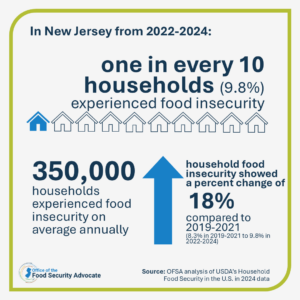
The problem of food insecurity in New Jersey is a complex issue. Estimates are that nearly 3 billion pounds of food are wasted annually in the Garden State while 1.1 million residents, including 270,000 children, experience food insecurity. Determining the root causes of this widespread issue is also complex.

The New Jersey Office of the Food Security Advocate (OFSA) partnered with the Center for Nutrition & Health Impact to develop and implement a set of measures framed around the six dimensions of food security: Stability, utilization, access, agency, availability, and sustainability. OFSA recently published a report outlining what it found to be the reasons why food insecurity occurs. This data collection initiative informs the OFSA’s strategic planning efforts to ultimately guide cross-sector collaboration and policy development regarding food insecurity throughout New Jersey. Also, findings can serve as a baseline from which future progress can be measured.

The full report is embedded here:

Exploring-the-Six-Dimensions-of-Food-Security-in-New-Jersey_October-2025

Table to Table is New Jersey’s first and largest food rescue nonprofit, bridging the gap between food being wasted and people facing food insecurity. We bring rescued fresh, nutritious food to 303 community partners, including social service organizations, pantries, shelters, fresh produce markets and centralized distribution hubs. Food is provided free of charge. Through this, Table to Table touches a diversity of those in need, including families, children, veterans, and older adults, making good nutrition accessible while serving as a stimulus for other longer-term benefits. Since 1999 we have rescued more than 120,700 tons of nutritious food—enough for 241,400,846 million meals—and delivered it to our neighbors in need, saving over 544 metric tons of methane saved.

Related:

New Jersey awarded $1.2 million in grants to 36 institutions of higher education to combat food insecurity on their campuses. The grants will support campus-based resources, including food pantries and outreach connecting students with the Supplemental Nutrition Assistance Program (SNAP).

The grants were awarded through the Hunger-Free Campus Act. Through the program, institutions achieve a Hunger-Free designation and work to address student hunger through a Campus Hunger Task Force, a physical campus food pantry, and awareness raising initiatives, the New Jersey Office of the Secretary of Higher Education said in a press release.

This round of awardees reflects the grant’s widest reach since being created in 2019, with 90% of all public colleges and universities and 57% of eligible independent public-mission institutions receiving funding. In total, the state has invested $6.4 million over the last six years to address food insecurity among college students under the Act.

“These awards are the latest example of New Jersey’s investment in making food security a reality for everyone, everywhere. For college students to get help completing school meal applications for their children or applying for SNAP, being welcomed to use donated meal credits or shop for their households, means alleviating the stress that can derail their studies,” said Mark Dinglasan, executive director of the New Jersey Office of the Food Security Advocate.

Grant awards for fiscal year 2026 are:

Atlantic Cape Community College$52,500
Bergen Community College$27,500
Brookdale Community College$17,500
Camden County College$27,500
Centenary University$27,500
County College of Morris$17,500
Drew University$17,500
Essex County College$52,500
Fairleigh Dickinson University$17,500
Felician University$52,500
Georgian Court University$27,500
Hudson County Community College$52,500
Kean University$52,500
Mercer County Community College$27,500
Middlesex College$27,500
Monmouth University$27,500
Montclair State University$52,500
New Jersey City University$52,500
New Jersey Institute of Technology$52,500
Ocean County College$17,500
Ramapo College$17,500
Raritan Valley Community College$27,500
Rowan College at Burlington County$27,500
Rowan College of South Jersey$27,500
Rowan University$27,500
Rutgers University, Camden$52,500
Rutgers University, New Brunswick$17,496
Rutgers University, Newark$52,500
Saint Peters University$52,500
Salem Community College$27,500
Stevens Institute of Technology$17,500
Stockton University$27,500
Sussex County Community College$27,500
The College of New Jersey$17,500
Union College of Union County, New Jersey$27,500
William Paterson University$52,504

OSHE applied a new equity-focused distribution model that considered each institution’s percentage of eligible students to reach those experiencing the greatest need and to respond following disruptions to those students receiving SNAP benefits. Findings from OSHE’s Spring 2025 Student Food Security Survey of 11,877 students show that half of Pell Grant-receiving respondents were food insecure. The survey also found:

  • Food insecurity among college students persists, affecting 36% of all student respondents and 50% of first-generation students.
  • Nearly half (45%) of students had difficulty affording balanced meals.
  • Even with lifeline federal assistance programs, 65% of students receiving SNAP and other federal assistance (TANF, WIC) reported experiencing food insecurity.

Related: