





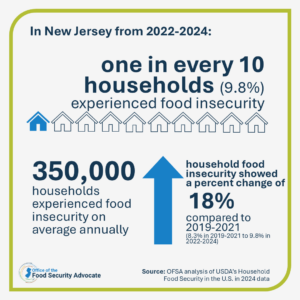
Food insecurity in New Jersey is increasing, with one in 10 households experiencing the status between 2022 and 2024, a new report by the U.S. Department of Agriculture (USDA) released recently shows.
“Household Food Security in the United States in 2024” provides state-level food insecurity prevalence rates, averaging data from 2022, 2023, and 2024. The New Jersey Office of the Food Security Advocate (NJOFSA) featured New Jersey-centric findings of the report on its website.
According to the report, between 2022 and 2024:
- One in 10 households, 9.8%, or about 350,000, experienced food insecurity in New Jersey, an increase from the 8.3% reported in 2019-2022
- New Jersey recorded the fifth lowest prevalence of household food insecurity in the United States
Although New Jersey’s 9.8% rate of food insecurity is below the national average of 13.3%, “any amount, and increases to, food insecurity is unsuitable for a state with our strong resources, partnerships, and commitment to ensuring food security for all,” the NJOFSA said in an update on its website.
What Is Food Insecurity?
There are two classifications of food insecurity, according to the USDA. One type is when there are “reports of reduced quality, variety, or desirability of diet,” but there is “little or no indication of reduced food intake.” The other, more serious type, is when there are “reports of multiple indications of disrupted eating patterns and reduced food intake.”
The USDA published its food security report for 30 years before announcing that the 2025 report would be its last one, calling the report and study behind it, “redundant, costly, politicized, and extraneous.” It was originally created to support the increase and eligibility of families and individuals to the federal Supplemental Nutrition Assistance Program (SNAP), commonly known as food stamps.
The NJOFSA said the report served as an “essential public resource for tracking trends and evaluating progress in food security,” providing the “most consistent national and state level data on household food insecurity.
“It grounds research, informs policy decisions, and helps advocates, agencies, and communities identify where people may struggle to afford enough food.”
As New Jersey’s first and largest food rescue, our mission is to reduce food waste and provide nourishment to our food-insecure neighbors throughout North Jersey. We rescue millions of pounds of fresh food annually that would otherwise be wasted and end up in landfills, contributing to climate change. We deliver it to partner organizations who support the nearly 1.1 million people in our area who need it most.
Together, we can reduce food waste in our home and make a positive impact on the planet. Every little bit of effort — no matter how small — leads to change.
Related: